
All four major banks now forecast rate cuts through 2027 — and lenders have already started cutting fixed rates. This update maps the next two years, right through to the 2028 federal election, and looks at the policy wildcard that could set up the next property cycle.
Where Are Rates Heading?
For the first time this cycle, every major bank forecast now points down — they just disagree on how bumpy the road gets first. Three of the four majors expect the cash rate to hold at 4.35% for the rest of 2026, with one still tipping two more hikes to a 4.85% peak by September. From there, every forecast converges: cuts through 2027, landing between 3.60% and 4.35% by December — and roughly 3.60–3.85% by the time Australia votes in 2028.
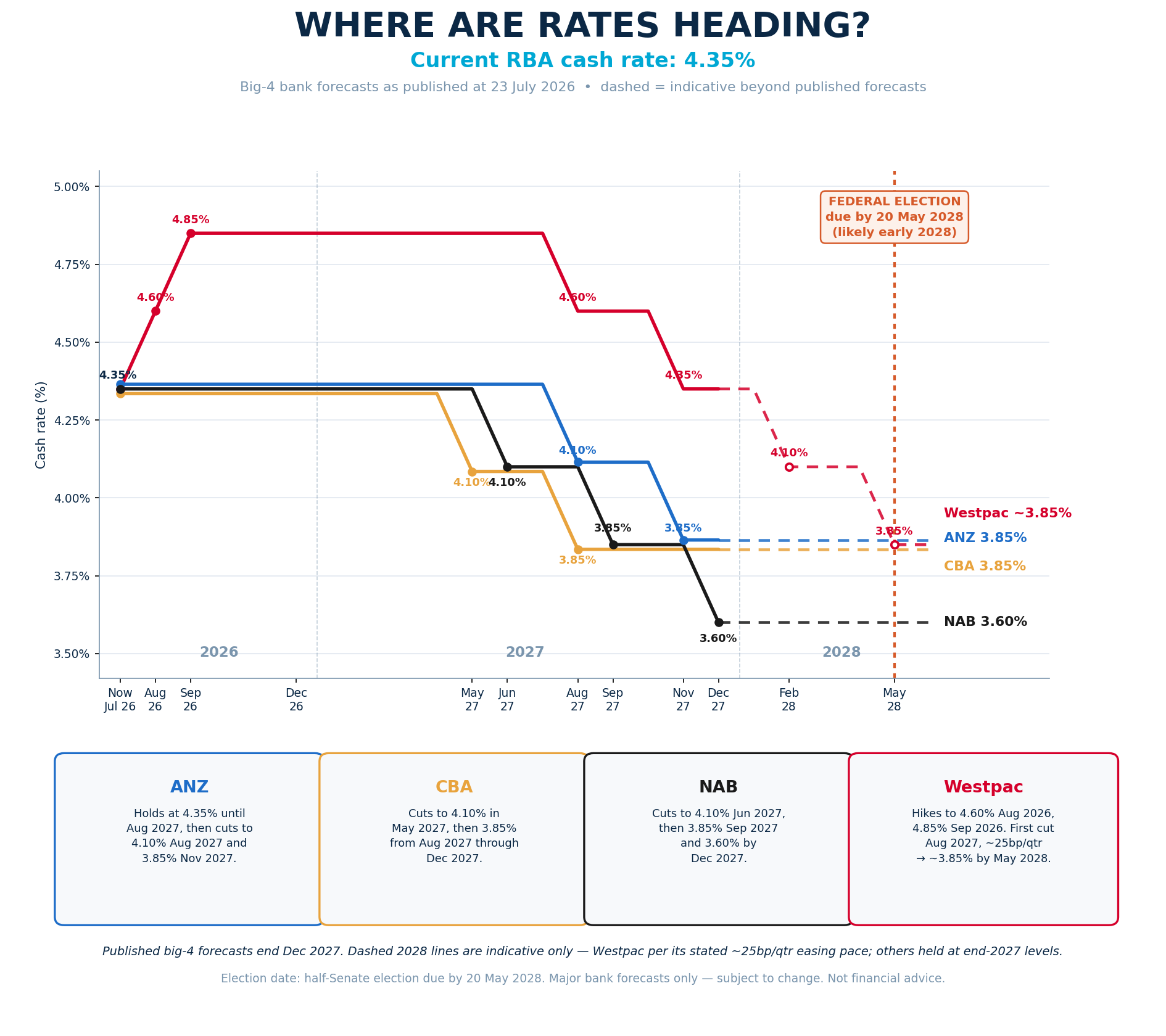
Published major-bank forecasts as at 23 July 2026. Dashed 2028 segments are indicative only — forecasts are subject to change.
Short term — hikes are still live
An August hike is still a real possibility, and the 29 July inflation print will likely decide it. The 2026 hikes so far have already trimmed borrowing capacity by roughly $25k for a single average-income borrower and $49k for a couple — another 0.25% would take that to about $37k and $73k. On a $600k loan, one more hike adds roughly $92 a month.
Long term — the turn is coming
Look past the next two meetings and the picture flips. Every major bank now forecasts an easing cycle through 2027, with the cash rate converging around 3.60–3.85% by early 2028. Lower rates mean restored borrowing power — and history says the market doesn’t wait for the last cut to move.
Our view: the exact month of the first cut matters less than the direction. The debate is no longer “up or down” — it’s “when, and how fast down.”
The Policy Wildcard: Three Times Property Tax Reform Blinked
Here’s the scenario I don’t think enough people are talking about. Last year’s negative gearing and CGT reforms don’t take effect until 1 July 2027, existing owners are grandfathered — and the Coalition has already pledged to repeal the changes if it wins the next election, due by May 2028. So there’s a real, non-zero chance these rules are amended or unwound just before or after Australia votes.
History gives that scenario more weight than you’d think:
Australia, 1985–87
Negative gearing was quarantined in July 1985 and reinstated in September 1987 amid pressure over the rental market. The original abolition lasted barely two years.
New Zealand, 2021–24
New Zealand began phasing out interest deductibility for residential investors in 2021. A change of government saw it fully restored by 2024 — the policy didn’t survive one election cycle.
Australia, 2016 & 2019
Labor took negative gearing and CGT changes to the 2016 and 2019 elections and lost both — then dropped the policy entirely in 2021. The electoral risk of property tax reform is well documented on both sides of politics.
Where it stands today
The May 2026 reforms take effect 1 July 2027: negative gearing ends for newly purchased established properties (existing holdings grandfathered, new builds exempt), and the 50% CGT discount is replaced with indexation plus a 30% minimum tax on gains. The Coalition has pledged to repeal both if elected. A survey of property professionals this month found tax reform has now overtaken interest rates as the most-cited downward pressure on prices — which is exactly why any reversal would matter so much.
Now line that up against the rate map above. If the easing cycle plays out as forecast and the tax settings flip back investor-friendly around the same time, that combination — cheaper money plus restored incentives, landing on a market that’s been holding its breath — is exactly the kind of setup that has kicked off previous property cycles. It’s a scenario, not a prediction. But it’s one worth positioning for, rather than reacting to after the fact.
Market Insights
Lenders are cutting fixed rates before the RBA moves
Twenty-one lenders have cut at least one fixed rate since 1 June, with reductions of up to 0.50 percentage points and the sharpest short-term fixed rates now starting with a 6. When lenders reprice fixed money down while the cash rate is still flat, it’s a strong signal the market believes the peak is in — or very close. If you’re weighing fixing versus variable, this is the window to review your options.
Two dates will set the tone for the rest of 2026
The June-quarter CPI lands on 29 July, and the RBA board meets 10–11 August. A soft inflation print likely locks in an extended hold; a hot one makes an August hike the base case. Either way, you’ll know within a fortnight which side of the forecast divide is winning.
Is your rate still competitive? Book a free 15-minute review →
This article is prepared by Assembly Finance for general information purposes only and does not constitute financial, tax or investment advice. Rate forecasts are the published views of the respective banks as at July 2026 and are subject to change. Commentary on possible policy changes is opinion about uncertain future events, not a prediction. Always consider your personal circumstances and seek independent advice before making financial decisions. Assembly Finance is a Credit Representative of Finsure Finance & Insurance Pty Ltd (Australian Credit Licence 384704).
